Urban Trajectory as a Language: Unveiling Insights into Human Mobility Patterns
posted on July 13, 2023 by Youngjun Park
Treating Urban Trajectory as a Language: Unveiling Insights into Human Mobility Patterns
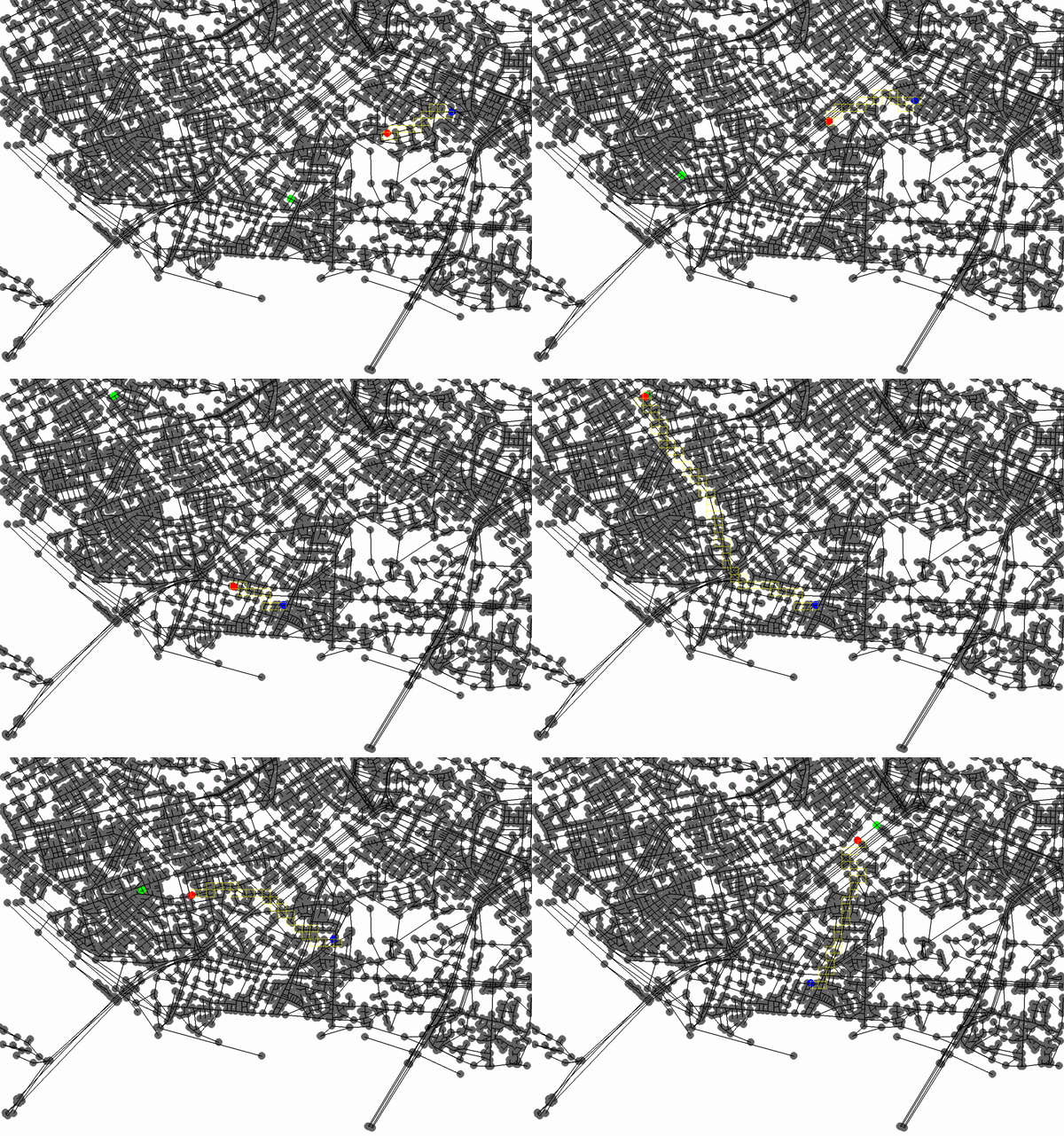
by Dr.Youngjun Park, CityImage
Background
In today’s rapidly evolving world, understanding human mobility patterns in urban areas has become increasingly important for effective urban planning and policy-making. Urban trajectory data, which tracks the movement of individuals through geographical coordinates and timestamps, provides valuable insights into these patterns. However, analyzing such spatio-temporal data poses computational challenges and requires innovative approaches. In this article, we introduce a novel approach that treats urban trajectory as a language, leveraging techniques from natural language processing to unlock hidden insights into human mobility patterns.
Urban Trajectory Data: Unlocking the Secrets of Human Mobility
Urban trajectory data is a rich source of information that reveals how individuals navigate through urban spaces. It encompasses various datasets, such as travel surveys conducted by countries annually and data generated by GPS devices and smartphones. These datasets capture the spatio-temporal dynamics of human movement, enabling us to understand patterns related to commuting, leisure activities, and social interactions. However, effectively analyzing urban trajectory data poses challenges due to its complex nature and computational demands.
Traditional Deep Learning Approaches: Limitations and Gaps
In the realm of deep learning models for urban space, two main approaches have emerged: the Convolutional Neural Network (CNN) method, primarily used for image-based data processing, and the Graph Convolutional Network (GCN), which leverages the structure of urban networks. While these approaches have provided valuable insights, they exhibit certain limitations when applied to urban trajectory data. They may lack efficiency, miss important contextual information, struggle to correctly embed spatial context, and often overlook the temporal sequence of movement.
Our Approach: Unleashing the Power of Language Models
To address these limitations, we propose a paradigm-shifting approach that treats urban trajectory data as sentences in a language. Inspired by the success of large language models, we draw techniques from natural language processing to extract hidden patterns and insights from urban trajectory data. By considering trajectories as sequences of spatial vector units, we apply word embeddings and attention mechanisms to analyze the urban trajectory sequences. Additionally, we leverage word embedding models from language processing to obtain compressed representations of the trajectory, enriching the features while minimizing computational load.
Our approach introduces the concept of “space to text” methods, including the use of 50x50 meter grid cells to represent individual trajectories. This representation captures the spatio-temporal changes of trips, enabling us to identify similarities in spatial patterns and leverage attention mechanisms to focus on important areas of interest. Additionally, techniques like GeoHash and node2vec contribute to our understanding of spatial context and enable effective modeling of human mobility patterns.
Future Research: Unlocking the Full Potential
As we embark on this exciting journey of treating urban trajectory as a language, several future research directions emerge. Firstly, we plan to conduct experiments to validate the effectiveness of our approach by comparing it with existing baseline models for human mobility prediction. Additionally, we explore the functional elements of urban trajectory, including orientation, destination, and link, to collaborate with activity-based transportation models. Drawing further inspiration from natural language processing, we delve into the functional elements of trajectories, their meanings and expressions, and similarities across different urban contexts.
Discussion: Advantages and Promising Applications
Our novel approach has significant implications for urban planning. By considering human mobility patterns with a focus on spatial context, we gain a deeper understanding of the underlying mechanisms that influence movement. Leveraging the techniques of natural language processing, we can easily input spatial information into deep learning models, enabling efficient data processing and informed decision-making. This approach opens doors for predicting future mobility patterns, designing public spaces and streets, and facilitating evidence-based urban planning.
In summary, our groundbreaking approach of treating urban trajectory as a language, and adapting natural language processing techniques, offers a fresh perspective on understanding and predicting spatio-temporal patterns of human mobility in urban areas. We anticipate that our results will demonstrate the advantages of this language-based approach and provide new insights into the intricate relationships between various factors that shape human mobility patterns. By unraveling the language of urban trajectories, we pave the way for smarter, more sustainable cities.
Note: This blog article is based on the research paper titled “Encoding Urban Trajectory as a Language: Deep Learning Insights for Human Mobility Pattern” by Youngjun Park and Sumin Han. The paper will be presented at the Association of Collegiate Schools of Planning (ACSP) conference 2023 in Chicago, IL. Paper